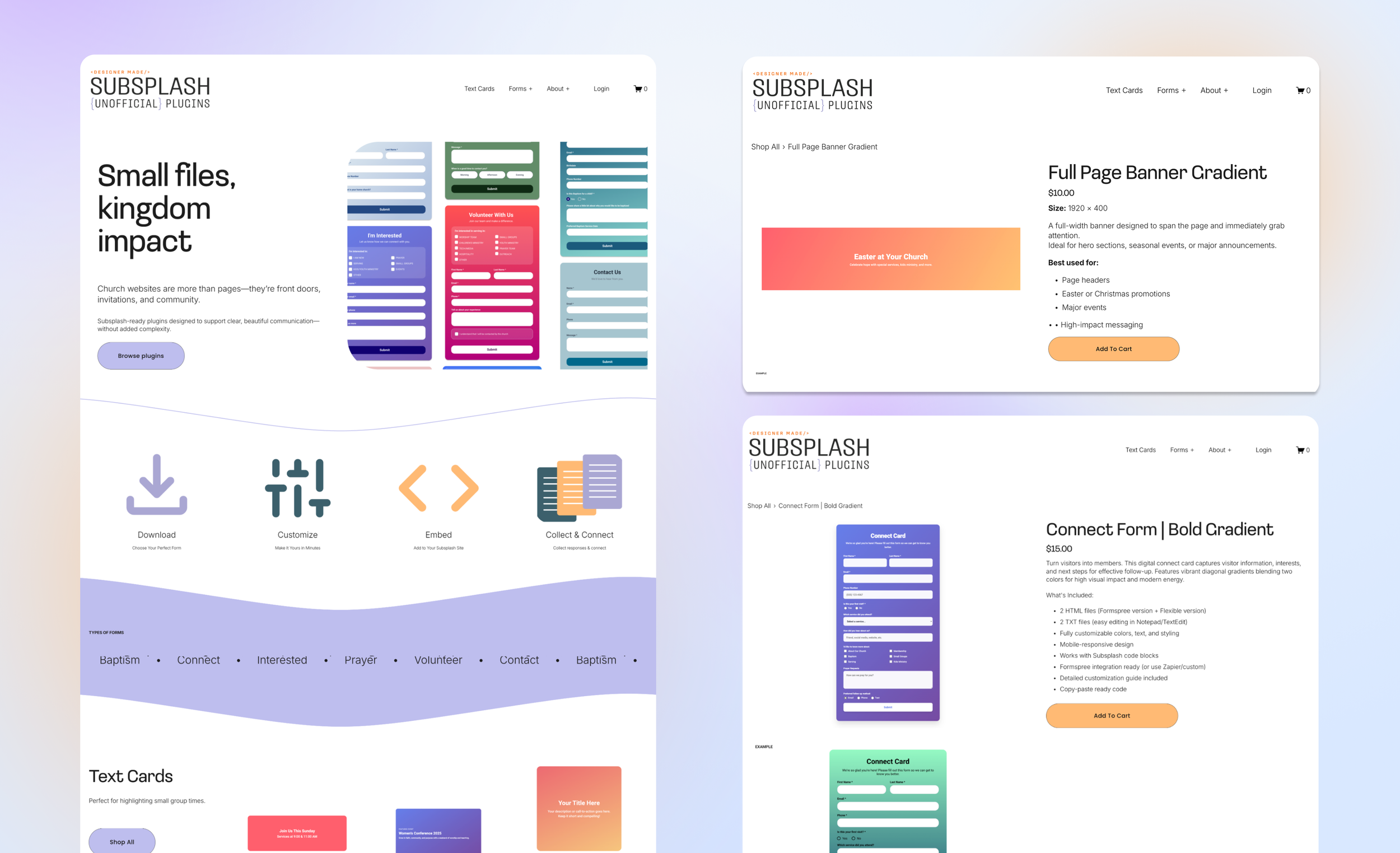
Subsplash Plugins: Product Innovation for Underserved Markets
Identified critical platform gaps while designing church websites - small organizations needed affordable customization options that didn't exist in Subsplash's ecosystem. Designed and developed a product line of coded plugins solving common church needs at accessible pricing, demonstrating how third-party solutions can fill platform limitations and serve overlooked customer segments.
Focus: Market gap analysis, accessible product design, customer education
Role: Product Designer & Developer
Tools: HTML, CSS, JavaScript, Figma
Timeline: Launching January 2026
The Gap
While redesigning Calvary Chapel's website, I repeatedly hit platform limitations: Subsplash offered no custom forms and no small, styled text blocks—only full-width banners. Churches were stuck between expensive workarounds: paying $156/year for Canva subscriptions to create text graphics, using third-party form builders with per-submission fees, or hiring agencies for $500+ per custom feature.
The insight: Thousands of small churches face identical constraints yet lack budgets for traditional solutions. The market gap wasn't just missing features - it was a lack of accessible implementation at church-appropriate pricing.
Product Strategy
Plugin Library
Developed a comprehensive library of coded solutions addressing the most common church needs:
Custom Forms
6 form types (contact, prayer, registration, volunteer, events, general inquiry)
5 style variations customers can choose from and customize
Each form integrates with any email service
Styled Text Blocks
4 text block options (schedules, announcements, callouts, verses)
Available in both solid color and gradient backgrounds
Fully editable without graphic design software
Each plugin is designed for specific use cases based on real church workflows - not generic templates, but purpose-built solutions churches can implement and customize to match their branding.
Implementation System
Designed a complete customer education experience:
Step-by-step PDF documentation showing exactly where to customize code
Email integration tutorials connecting forms to church addresses
Cost breakdown tools demonstrating value vs. alternatives
Color customization guides (line-by-line instructions)
Troubleshooting resources for common issues
Accessibility Through Education
Rather than building expensive drag-and-drop tools, I invested in making code accessible. Users need basic technical ability, but documentation eliminates guesswork - every decision point is explained, every customization documented.
Innovation & Differentiation
Pricing Model Disruption
One-time $15 purchase with unlimited usage - disrupting subscription models and per-use fees dominating the market. When churches buy four plugins for less than one month of Canva, the value proposition is undeniable.
Product-Market Fit
Serving the overlooked segment: churches that can't afford agencies but will invest time learning if barriers are low enough. This isn't hobbyist pricing - it's strategic market entry into an underserved $10M+ addressable market.
Customer-Centric Design
Built multiple preconfigured variations rather than complex customization tools - churches choose what fits their needs without paying for features they won't use. This reduces decision fatigue while keeping costs affordable.
Validation & Impact
Real-World Implementation
Already deployed on Calvary Chapel's website, replacing Canva workflow with editable text blocks. What required 10 minutes and design software now takes 30 seconds of text editing - proving the product solves real operational pain.
Scalability Beyond Subsplash
Platform works for any website builder with code injection; Subsplash is the entry point, but the opportunity extends across the entire church tech ecosystem.
Product Vision
This demonstrates how understanding platform constraints AND customer workflows creates opportunities for innovation. Third-party ecosystems can serve customers, platforms that haven't prioritized expanding capability without rebuilding core infrastructure.
Where it’s going
Currently pre-launch - building the infrastructure to get these plugins into churches' hands. I've proven the concept works through real implementation at Calvary Chapel. Now it's about distribution: getting affordable solutions to the thousands of small churches stuck between expensive agencies and limited platform features.
The bigger picture? This shows what's possible when you understand both the platform's technical constraints and the customer's real workflows. You can design solutions that fill gaps at scale - whether through third-party products like this or by bringing that insight directly into platform development.
I built this to solve my own frustration - and that's the best part about being a designer who codes. When something's broken, you can actually fix it instead of just complaining about it.