
Merlin Patient Portal: Real-time transparency for cancer patients during treatment
Drawing on 6 years of healthcare UX experience, I designed Merlin to address a critical gap in patient experience: the lack of real-time transparency that patients expect from every other industry.
I revisited this case study after growing as a designer and product thinker, and overhauled the strategy, structure, and writing below.
Project Details:
Type: Strategic Design Exploration
Role: End-to-end Product Strategy & Design
Focus: Two-sided platform for patient experience + hospital operations
Expertise Applied: Healthcare UX, service design, operational efficiency, privacy-compliant design
Software: Figma
The Problem
The Transparency Gap
Cancer patients wait an average of 183.5 minutes from arrival to treatment¹, with no visibility into delays, doctor availability, or when they should actually show up. Airports post flight delays. Restaurants text when your table's ready. Ride-share apps track your driver in real time. Healthcare — where the stakes are highest — leaves patients in the dark.
The infrastructure to fix this already exists inside most hospitals: barcode systems, patient tracking, scheduling software. What's missing is a patient-facing layer that surfaces that data without violating privacy.
The Challenge:
Design a platform that gives patients flight-tracker-level transparency and gives hospitals operational insight to improve efficiency — within healthcare's privacy and regulatory constraints.
Research & Approach
I studied wait-time research in oncology settings, looked at transparency models from airlines and transportation apps, and dug into how hospital operational systems already track patients internally.
Key Insights:
Patients feel powerless during medical uncertainty - transparency reduces anxiety
Hospitals have tracking data but no patient-facing communication layer
Real-time updates must balance transparency with HIPAA privacy requirements
The same operational data that helps patients can help hospitals spot bottlenecks.
Design Considerations
Privacy & Compliance
Status updates are anonymized by design — "Doctor is with a previous patient," never "with Patient X." Tracking is opt-in and patient-controlled, and built to meet HIPA
Implementation Strategy
Full deployment means real system integration work. I designed for a phased rollout: start with high-volume, predictable appointments (routine checkups, scheduled infusions), then expand into more complex care — a path that respects how legacy hospital systems actually work while still proving out the value early.
The solution: two-sided platform
Patient Experience
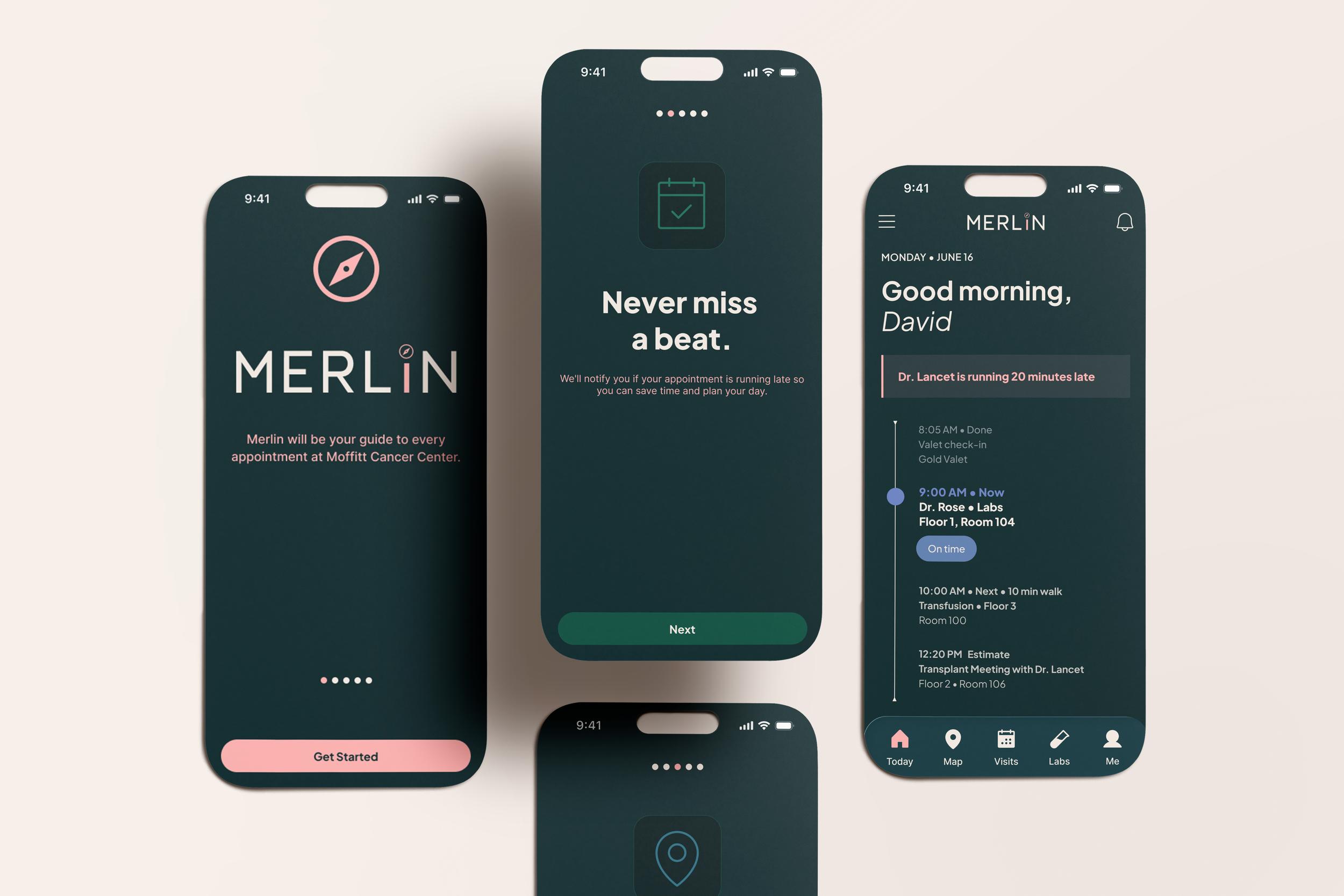
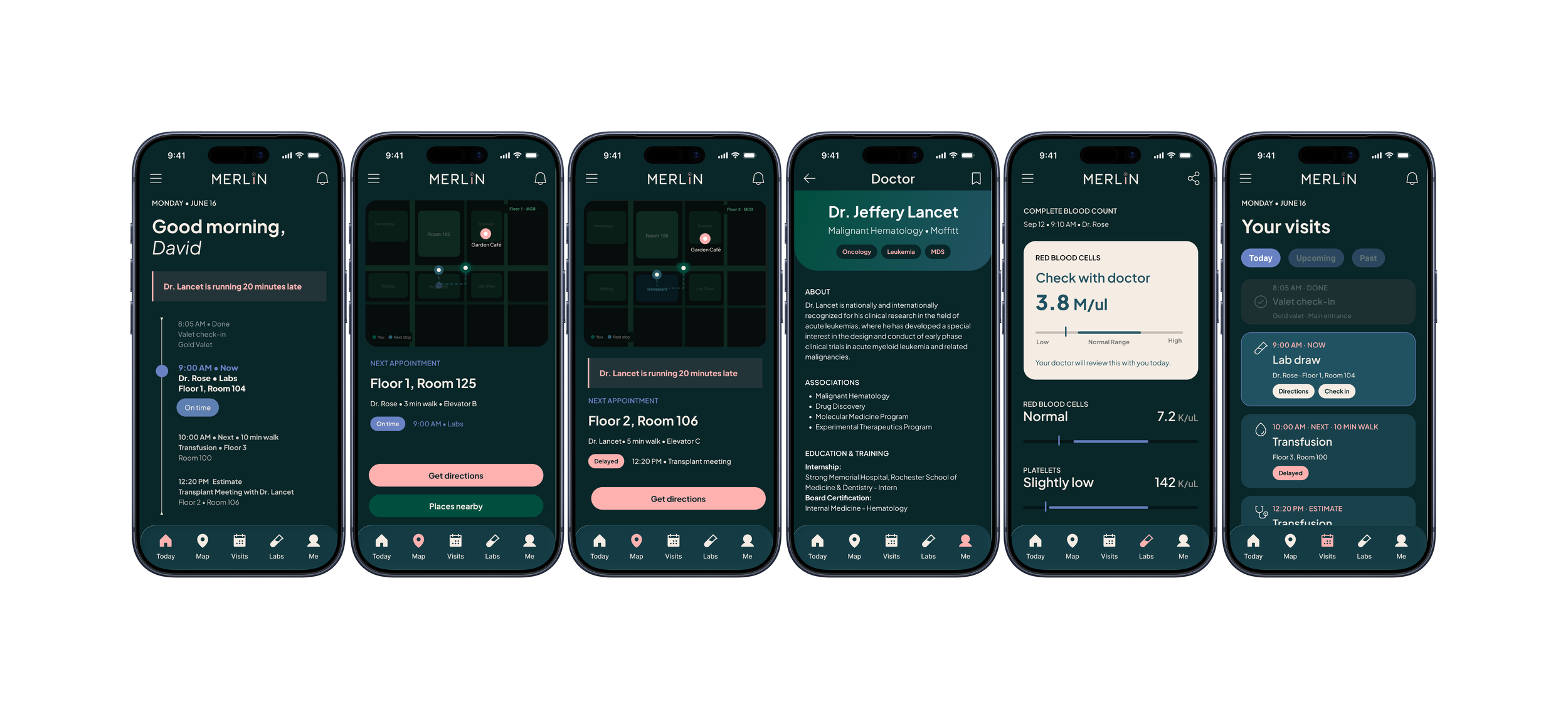
Real-time appointment intelligence, with notifications like "Your doctor is running 30 minutes late — arrive at 10:30 instead of 10:00." Status updates track visible progress: Doctor with previous patient → Lab processing results → Ready for you.
Seamless Hospital Experience
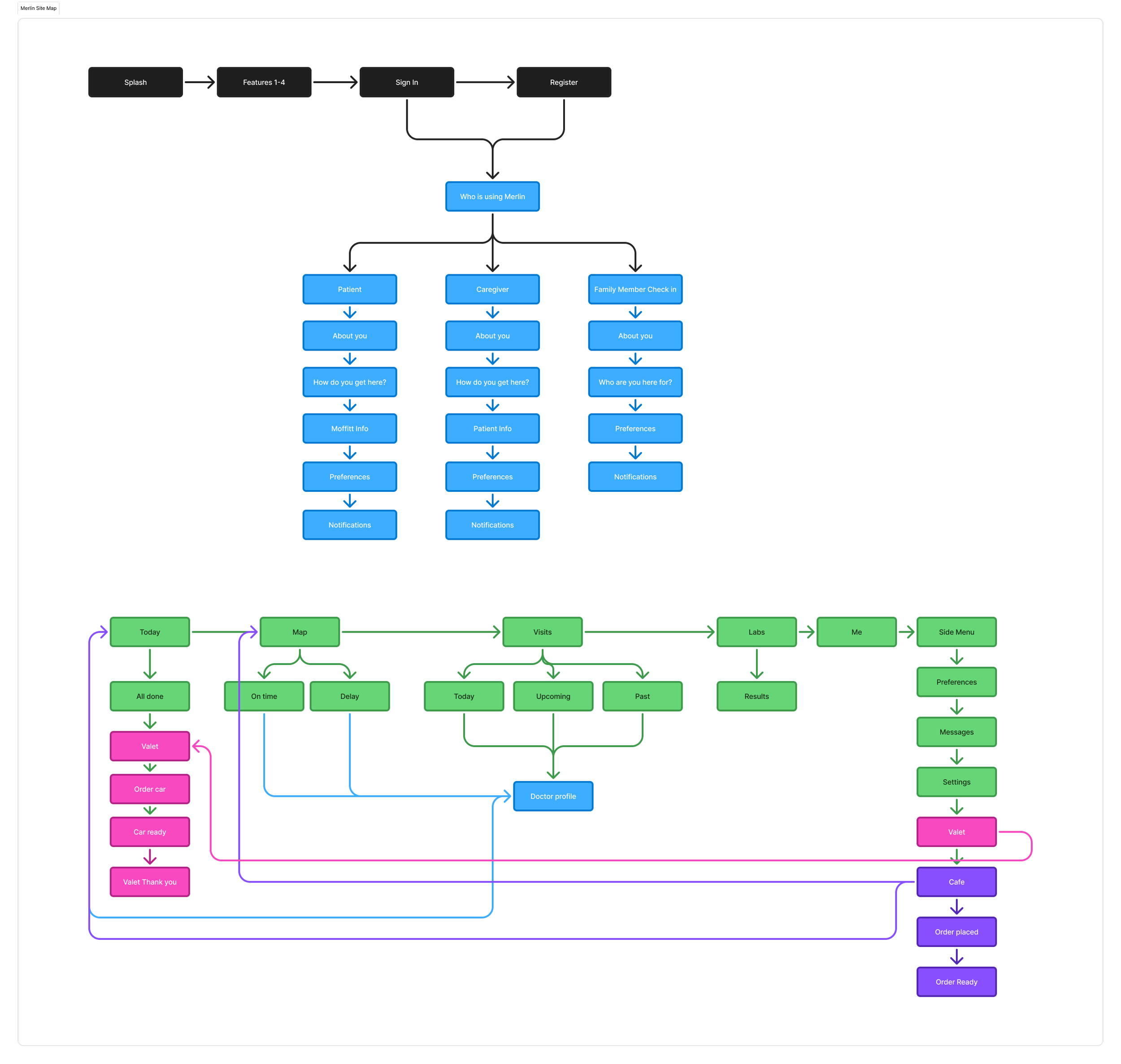
QR code check-in (like mobile boarding pass) eliminates front desk wait
Turn-by-turn indoor navigation for large hospital campuses
In-app food ordering timed to appointment status
Automated valet: request car pickup from treatment room
Unified view: appointments, results, messages, prescriptions
Hospital Operations Dashboard
Efficiency Analytics Real-time visibility into bottlenecks (pharmacy delays, lab processing times), average wait times by department and doctor, patient flow visualization, and no-show pattern analysis.
Process Optimization Data-driven scheduling improvements, resource allocation based on actual appointment durations, and predictive modeling for better capacity planning.
The Impact
For Patients: less wasted time, less anxiety, more control during an already vulnerable moment. For Hospitals: data-driven operational improvements, fewer no-shows, a real competitive differentiator.
Healthcare's complexity is exactly why it needs thoughtful design intervention. Merlin reframes transparency not as a feature request, but as a service design problem — and that reframe is the real contribution here.
¹ Mahrous M, El Shaer E, Rezik L, Taha S, Yosef A. Decreasing prolonged waiting times for chemotherapy administration for patients with cancer. Global Journal on Quality and Safety in Healthcare. 2018;1(2):44-48.
Old Design

